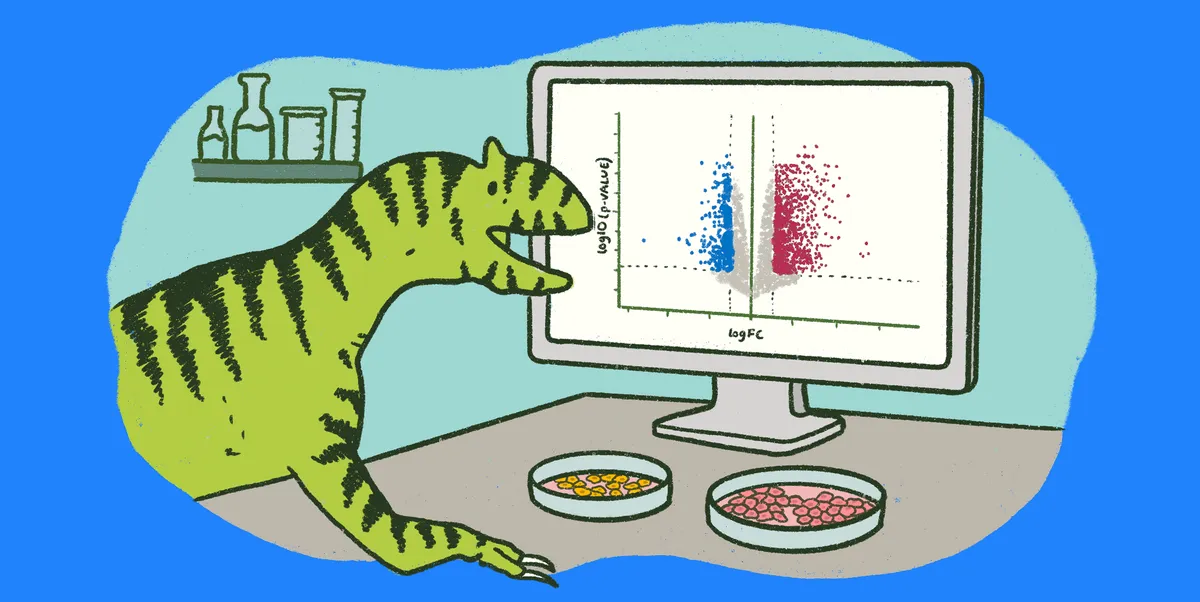
Plasmidsaurus built its reputation on the premise that sequencing should be fast enough to be an afterthought. Since launching RNA-Seq last October, the company has been testing whether that premise holds for transcriptomics, a field long defined by slow turnaround times, expensive workflows, and logistical headaches. Two announcements released this week suggest the answer is yes, and that the company is moving quickly to extend that promise globally.
The first is the expansion of RNA sequencing to its hub in Cologne, Germany, which cuts turnaround times for European researchers from five days to three. The second is SEQguard™ Dino Preserve, an RNA stabilization reagent developed with Swedish biotech Genovis that allows purified RNA to ship at ambient temperature, no dry ice required.
The Cologne expansion was a direct response to early user feedback. "We built Plasmidsaurus RNA-seq around a simple idea: once you can measure the whole transcriptome quickly, simply, and affordably, measuring a handful of genes no longer makes sense," Mark Budde, CEO and co-founder of Plasmidsaurus noted, "That’s what we’re seeing now. Scientists are moving beyond RT-qPCR and getting a far richer picture of biology." But the two-day shipping penalty for European customers was a friction point that the team moved quickly to resolve. Cologne was a natural choice. Plasmidsaurus already operated a long-read nanopore sequencing facility there, staffed with trained personnel and equipped with lab automation infrastructure. The facility sits near Cologne/Bonn Airport, a twenty-four-hour air cargo hub connecting over two hundred twenty countries, which matters when results are promised in days rather than weeks.
The Genovis partnership addressed a separate but equally stubborn bottleneck. For decades, purified RNA has required cold chain shipping, a mandatory logistical burden that adds cost, complexity, and environmental overhead to every experiment. SEQguard™ Dino Preserve eliminates that requirement. The synthetic reagent is thermostable, tolerates freeze-thaw cycles, and stabilizes twenty-four RNA samples per one hundred fifty microliter vial. It ships and stores at room temperature.
"By partnering with Genovis to bring SEQguard™ Dino Preserve into the Plasmidsaurus ecosystem, we're making high-quality RNA-seq as simple and reliable as dropping off a tube at a local dropbox," said Budde. "Together, we eliminate the logistical headache so customers can focus on their science, not shipping."
The company chose to partner rather than develop the preservative in-house because Genovis brought specialized expertise in biomanufacturing and sample preservation that Plasmidsaurus could leverage immediately. The result feeds directly into Plasmidsaurus's existing dropbox network, meaning a researcher in Frankfurt or Lyon can now submit a stabilized RNA sample at room temperature, through a local drop point, and receive analyzed transcriptomic data within three days.
That positions Plasmidsaurus as a serious competitor to RT-qPCR for routine gene expression work, not just large-scale profiling projects. "Bench scientists have traditionally viewed RNA-seq as a slow, expensive, and technically challenging research method," the company acknowledged. The goal, per Budde's team, is to make it a standard tool for everyday experimental biology. Coming improvements include virtual gene panels that map onto defined biological pathways, replacing primer design entirely and bringing the workflow closer to the simplicity that made plasmid sequencing a daily habit for thousands of researchers.
The Cologne hub and SEQguard™ Dino Preserve launch follow a year of rapid expansion. Plasmidsaurus has added overnight microbiome amplicon sequencing, and RNA-seq to a core built on whole-plasmid sequencing, where the company outperformed four rival vendors in an independent benchmark study by Dr. Adam Rosenthal at UNC Chapel Hill, returning results up to six times faster with the fewest sequencing errors across forty-two complex samples.
For a company that built its brand on the tagline "we sequence while you sleep," these latest moves are a logical extension. The bottleneck in transcriptomics was never the sequencer. It was everything else. Plasmidsaurus is eliminating those one friction point at a time.
Read More

Newletter & More








SynBioBeta
Join the innovators shaping the future with SynBio + AI. From health to ag, materials & more—be part of the revolution.